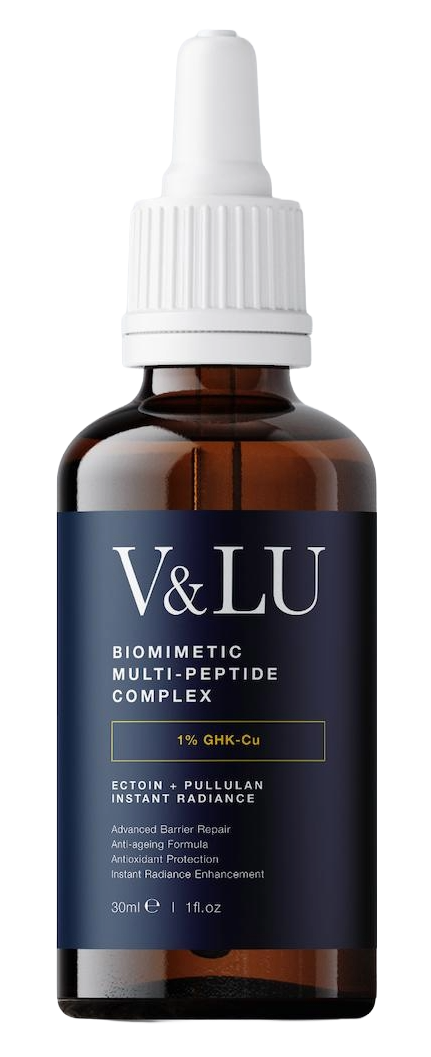
What it is,where it came from.
Copper tripeptide-1 is a chain of three amino acids — glycine, histidine, lysine — carrying a single copper ion.
It isn’t a laboratory invention. GHK occurs naturally in human plasma, which is where it was found in the first place.
In the early 1970s, a biochemist named Loren Pickart was working on a question about ageing tissue. He’d noticed that liver cells behaved differently depending on whose blood plasma they were kept in — plasma from younger donors seemed to keep older tissue behaving more like young tissue.
Rather than accept that as a curiosity, he went looking for the reason, and isolated a small tripeptide from the plasma. That was GHK. The copper affinity came later: GHK binds copper ions readily, and the resulting complex turned out to be considerably more biologically active than the peptide alone.
The finding that made it interesting to skincare came from measuring it across ages. GHK levels in plasma sit around 200 ng/mL in your twenties and fall to roughly 80 ng/mL by sixty. More than half of it gone, over roughly the same period people start noticing changes in skin firmness.
How it works
Copper is the point, and the peptide is the delivery system. The enzymes that assemble collagen and cross-link elastin depend on copper as a cofactor. Without it they don’t function properly. But loose copper ions are reactive and unstable — you cannot simply put copper in a bottle and expect anything good to happen.
The delivery system
GHK holds copper in a stable complex and carries it where it’s useful. The peptide portion also acts as a signalling molecule in its own right, interacting with fibroblasts — the cells responsible for producing the skin’s structural proteins.
Signalling, not stripping
That’s what separates it from most actives. Retinoids work by accelerating cell turnover. Acids work by removing the surface layer. Copper peptides work by signalling, which is why they’re generally better tolerated and why results build gradually rather than arriving with a peeling phase.
What the research supports
GHK-Cu has one of the longer research trails in cosmetic science — decades of published work covering collagen and elastin synthesis, fibroblast activity, antioxidant pathways and gene expression. The most quoted comparison put copper tripeptide against two established dermatological actives over a month. Copper tripeptide showed collagen production increases in around seventy percent of participants, against fifty percent for vitamin C and forty percent for tretinoin.
The caveat, which most brands leave out
A great deal of that work is laboratory or animal research. The human trials are small — dozens of participants, not thousands. The ingredient is well evidenced by cosmetic standards, but cosmetic standards are not pharmaceutical standards, and anyone telling you copper peptides are clinically proven to do a specific thing to your face is overstating what exists. We’d rather say that than not. If we’re going to argue that the industry is imprecise about numbers, we can’t be imprecise about evidence.
Why one percent
One percent sits at the upper end of what’s practical in a finished serum. Higher isn’t automatically better. Copper is reactive, and increasing the concentration increases the likelihood of irritation faster than it increases any benefit. Products exist at two and three percent, and there’s a reasonable argument for them, but the more useful question is always whether the number quoted is the peptide or the solution.