01  THE SCIENCE

What’s actually in acopper peptide serum

Copper peptide serums are unusually hard to compare. Two bottles can carry the same number on the front and hold wildly different amounts of the active. Here’s why that happens, what the research on GHK-Cu actually says, and what’s in ours.

1%
Pure GHK-Cu, not diluted solution
2%
Ectoin, within the clinical window
+70%
Collagen synthesis vs vitamin C, tretinoin
0
EDTA, fragrance, colourants
02  THE NUMBER ON THE BOTTLE

The numberon the bottle.

Peptides rarely arrive at a factory as pure powder. They come as solutions — the active dissolved in water, usually at well under one percent. That’s how they stay stable, and it’s how the industry trades them.

So when a label says one percent, it can mean one percent of the peptide, or one percent of a liquid that is mostly water. Both are honest ways to write it. They describe very different products.

SNAP-8 is the clearest example. The raw material is around 0.05% active. A formula containing ten percent of it holds one twentieth of one percent of the peptide itself — and can still, quite legitimately, list SNAP-8 on the box.

The same applies to copper peptide. This is why comparing two serums on their front-of-pack numbers tells you almost nothing.

We quote pure actives. Our 1% GHK-Cu is one percent copper tripeptide-1.

Position in the ingredient list
Ingredients present above one percent must be listed in descending order of weight. Below one percent they can appear in any order. So if copper tripeptide-1 sits well down the list, you’re looking at a trace amount — but if it sits near the top, that’s meaningful.
EDTA
Chelating agents exist to bind metal ions. Copper is a metal ion. A copper peptide serum containing EDTA is working against its own hero ingredient. There is none in ours.
Colour
Copper in solution is blue. If a copper peptide serum is clear, there isn’t much copper in it. If it’s blue and the ingredient list shows no colourant, that colour is the active itself.
Peptide count
A serum listing ten peptides is usually listing ten peptides at trace levels. There’s only so much room in a formula, and peptides at functional concentrations are expensive.
03  GHK-CU, 1%

What it is,where it came from.

Copper tripeptide-1 is a chain of three amino acids — glycine, histidine, lysine — carrying a single copper ion.

It isn’t a laboratory invention. GHK occurs naturally in human plasma, which is where it was found in the first place.

In the early 1970s, a biochemist named Loren Pickart was working on a question about ageing tissue. He’d noticed that liver cells behaved differently depending on whose blood plasma they were kept in — plasma from younger donors seemed to keep older tissue behaving more like young tissue.

Rather than accept that as a curiosity, he went looking for the reason, and isolated a small tripeptide from the plasma. That was GHK. The copper affinity came later: GHK binds copper ions readily, and the resulting complex turned out to be considerably more biologically active than the peptide alone.

The finding that made it interesting to skincare came from measuring it across ages. GHK levels in plasma sit around 200 ng/mL in your twenties and fall to roughly 80 ng/mL by sixty. More than half of it gone, over roughly the same period people start noticing changes in skin firmness.

How it works
Copper is the point, and the peptide is the delivery system. The enzymes that assemble collagen and cross-link elastin depend on copper as a cofactor. Without it they don’t function properly. But loose copper ions are reactive and unstable — you cannot simply put copper in a bottle and expect anything good to happen.
The delivery system
GHK holds copper in a stable complex and carries it where it’s useful. The peptide portion also acts as a signalling molecule in its own right, interacting with fibroblasts — the cells responsible for producing the skin’s structural proteins.
Signalling, not stripping
That’s what separates it from most actives. Retinoids work by accelerating cell turnover. Acids work by removing the surface layer. Copper peptides work by signalling, which is why they’re generally better tolerated and why results build gradually rather than arriving with a peeling phase.
What the research supports
GHK-Cu has one of the longer research trails in cosmetic science — decades of published work covering collagen and elastin synthesis, fibroblast activity, antioxidant pathways and gene expression. The most quoted comparison put copper tripeptide against two established dermatological actives over a month. Copper tripeptide showed collagen production increases in around seventy percent of participants, against fifty percent for vitamin C and forty percent for tretinoin.
The caveat, which most brands leave out
A great deal of that work is laboratory or animal research. The human trials are small — dozens of participants, not thousands. The ingredient is well evidenced by cosmetic standards, but cosmetic standards are not pharmaceutical standards, and anyone telling you copper peptides are clinically proven to do a specific thing to your face is overstating what exists. We’d rather say that than not. If we’re going to argue that the industry is imprecise about numbers, we can’t be imprecise about evidence.
Why one percent
One percent sits at the upper end of what’s practical in a finished serum. Higher isn’t automatically better. Copper is reactive, and increasing the concentration increases the likelihood of irritation faster than it increases any benefit. Products exist at two and three percent, and there’s a reasonable argument for them, but the more useful question is always whether the number quoted is the peptide or the solution.

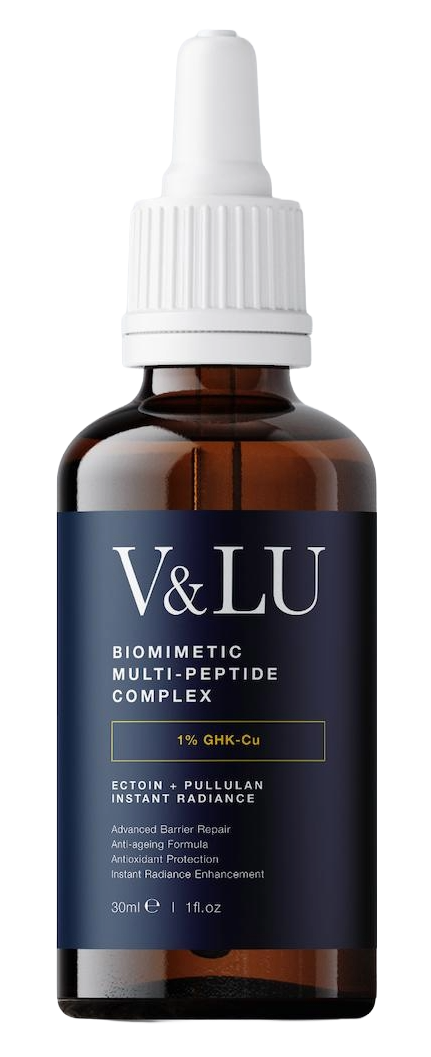
Shop the Copper Peptide Serum →

04  ECTOIN, 2%

The survivalmolecule.

Ectoin is an extremolyte — a survival molecule, produced by microorganisms living somewhere they have no business surviving.

It was identified in bacteria from a salt lake in the Egyptian desert, in water concentrated enough to destroy the cellular machinery of almost anything else. Those bacteria manufacture ectoin to stay intact.

It isn’t a humectant, and this distinction matters. A humectant draws water into the skin. Ectoin organises the water that’s already there — forming a structured shell around proteins and cell membranes that stabilises them under stress.

The mechanism has a name in biochemistry: preferential exclusion. The molecule doesn’t interfere with normal cellular function; it sits around it, holding a protective layer of water in place.

The practical effect on skin is better hydration retention and more resilience against environmental stress — pollution, UV exposure, temperature, the ordinary daily assault.

Why two percent
Published work on topical ectoin points to a range of roughly one to three percent for measurable effect on hydration and water loss through the skin barrier. Below that it’s a mild hydrator. Within it, the barrier effects show up.
Middle of the window
Two percent puts it in the middle of that window, and makes it the second largest active in the formula.
The clearest difference
Almost no copper peptide serum contains it at all. That’s the single clearest difference between this formula and the ones it sits alongside.
05  THE PEPTIDE COMPLEX

The peptide complex.

GHK-Cu does the structural work. Alongside it sit four synthetic peptides, chosen because they act on a different mechanism — signalling rather than building.

SNAP-8 (acetyl octapeptide-3)

A newer-generation neuropeptide, developed as a successor to Argireline. It works on the same pathway — the signalling cascade behind repeated muscle movement — but targets a broader section of it. Most commonly used in serums aimed at expression lines around the eyes and forehead.

Argireline (acetyl hexapeptide-8)

The best known peptide in skincare after GHK-Cu, and the one SNAP-8 was designed to improve on. It’s been in cosmetic use for over two decades, included here alongside rather than instead of SNAP-8.

Matrixyl 3000 (palmitoyl tripeptide-1 and palmitoyl tetrapeptide-7)

Not one peptide but two, used together — which is why the pairing has its own trade name. Both are matrikines: fragments that mimic the signals released when the skin’s own matrix breaks down, prompting fibroblasts to respond as they would to repair. Palmitoyl tripeptide-1 is associated with collagen support; palmitoyl tetrapeptide-7 with the inflammatory side of ageing. Together they’re among the most widely used peptides in anti-ageing formulation.

06  THE REST OF THE FORMULA

The rest of the formula.

Panthenol, 2%
Provitamin B5. Converts to pantothenic acid in the skin. Comfort and hydration, at a level that does something rather than a level that fills out a label.
Niacinamide
Vitamin B3, supporting the look of an even complexion.
Ceramide NP and Phosphatidylcholine
Lipids your own skin barrier is partly built from.
Pullulan
A polysaccharide produced by fermentation. It leaves a fine film across the surface that catches light, so skin looks smoother immediately after application.
Sodium hyaluronate and sodium PCA
Humectants holding water at the surface.
No EDTA. No fragrance. No colourants.

Shop the Copper Peptide Serum →

07  USING IT

Using it.

Two or three drops on clean skin, once a day. Follow with moisturiser, and sunscreen if you’re using it in the morning.

Copper peptides don’t sit well in the same layer as strong acids or direct vitamin C — low pH destabilises the complex. Different times of day solves it entirely.

Give it six to eight weeks. Signalling ingredients work on the skin’s own timescale, and that timescale is measured in cell cycles, not days.

WHAT TO EXPECT
First application
A smoother surface and a slight glow. That’s the film-former, and it’s cosmetic — it washes off.
Two to three weeks
Skin generally feels more comfortable and better hydrated. This is where ectoin and panthenol are doing most of the work.
Six to eight weeks
Where the copper peptide benefits start showing, if they’re going to. Firmer-looking skin, softer-looking fine lines, more even texture. Gradual rather than dramatic.
Three months and beyond
GHK-Cu benefits are cumulative. The research measures change over months, and so should you.

What it won’t do. It won’t replace sunscreen, it won’t fill deep lines, and it won’t work faster if you use more of it. Copper peptides reward consistency, not enthusiasm.

If you want to track it properly, take a photo in the same light on day one and don’t look at it again until week eight. Daily comparison tells you nothing.

08  QUESTIONS

Are copper peptides better than retinol?

They’re not competing. Retinol accelerates turnover and can irritate. Copper peptides signal and are generally well tolerated. Plenty of people use both, at opposite ends of the day.

Can I use this with vitamin C?

Not layered together. Vitamin C’s low pH destabilises the copper complex. One in the morning, one at night.

What is SNAP-8?

Acetyl octapeptide-3 — a peptide developed as a successor to Argireline, targeting the appearance of expression lines.

What is Matrixyl 3000?

A combination of palmitoyl tripeptide-1 and palmitoyl tetrapeptide-7, two peptides used together to support the skin’s own repair signalling.

Can you use copper peptides with other peptides?

Yes. Unlike acids and vitamin C, peptides work alongside each other without destabilising the copper complex. That’s why this formula combines them.

How long until I see something?

Immediate smoothness from the film-former. Anything structural, six to eight weeks minimum.

Is it suitable for sensitive skin?

It’s fragrance-free and colourant-free, and copper peptides are among the gentler actives. As with anything, patch test.

Why is it blue?

Copper. Not dye.

Does it replace sunscreen?

No. Nothing in this bottle protects against UV. Use SPF over it in the morning.

Our promise to you

Backed by science. Made with care. Made for you.

We are committed to creating high-performance skincare that respects your skin and the planet. Every V&LU bottle carries our signature — your assurance that the formula inside meets our uncompromising quality standards.

Shop the Copper Peptide Serum →

Close Menu